1. The Polish-Ottoman Hero Who Taught Europe to Drink Coffee
To understand Lviv’s enduring obsession with coffee, one must begin with a man whose story feels almost too cinematic to be true: Yurii-Frants Kulchytsky, a native of the Lviv region whose adventures connected the coffee traditions of the Ottoman world with the cafés of Central Europe.
In 1683, Vienna was under siege by the Ottoman army. With the city surrounded and communication with the outside world becoming increasingly difficult, Kulchytsky volunteered for a dangerous mission. Fluent in Turkish and familiar with Ottoman customs, he disguised himself as an Ottoman soldier and managed to pass through enemy lines. He carried messages between the besieged city and the allied forces preparing to come to its aid.
His mission succeeded. When the siege was finally broken, Kulchytsky was celebrated as a hero and was reportedly allowed to choose a reward from the enormous Ottoman stores left behind by the retreating army.
His choice was unusual.
Rather than taking gold, weapons, or valuable textiles, Kulchytsky selected hundreds of sacks of coffee beans.
At the time, coffee was still an exotic and largely unfamiliar drink in much of Europe. The beans Kulchytsky acquired were considered strange and even useless by some of his contemporaries. But he understood their value. Soon afterward, he established one of Vienna’s early coffee houses, traditionally associated with the name “Under the Blue Bottle” (Hof zur Blauen Flasche).
There was only one problem: many European customers found traditional Ottoman coffee too strong and bitter.
Kulchytsky adapted the drink to local tastes, reportedly adding milk and sweeteners. What emerged was a softer, more approachable style of coffee that helped establish the Viennese coffee-house tradition.
The historical details surrounding Kulchytsky’s life have been embellished over the centuries, but his legend remains deeply embedded in Central European coffee culture. And for Lviv, the story carries a special significance: the coffee hero was connected to the region itself.
This connection helps explain why coffee in Lviv feels less like an imported fashion and more like something deeply woven into the city’s identity.
Walk through the old center early in the morning and the evidence is everywhere. Cafés open their doors onto narrow streets, espresso machines begin their first hiss of the day, and the smell of freshly ground beans drifts through courtyards that have existed for centuries.
In Lviv, coffee is not simply something you drink.
It is part of the city’s historical vocabulary.
2. Where Coffee Is Mined: The Legend of the Underground Reserves
Ask a local where Lviv’s coffee comes from and, if they are in the mood for a joke, you may receive an unexpected answer:
It is mined.
According to one of Lviv’s most entertaining modern legends, enormous underground reserves of coffee lie beneath the historic center.
Far below the cobblestone streets, in a mysterious network of vaulted cellars and forgotten passages, imaginary miners search for precious coffee deposits. Instead of coal or salt, they extract green coffee beans from the walls of the underground city.
The story is deliberately absurd — and that is precisely what makes it memorable.
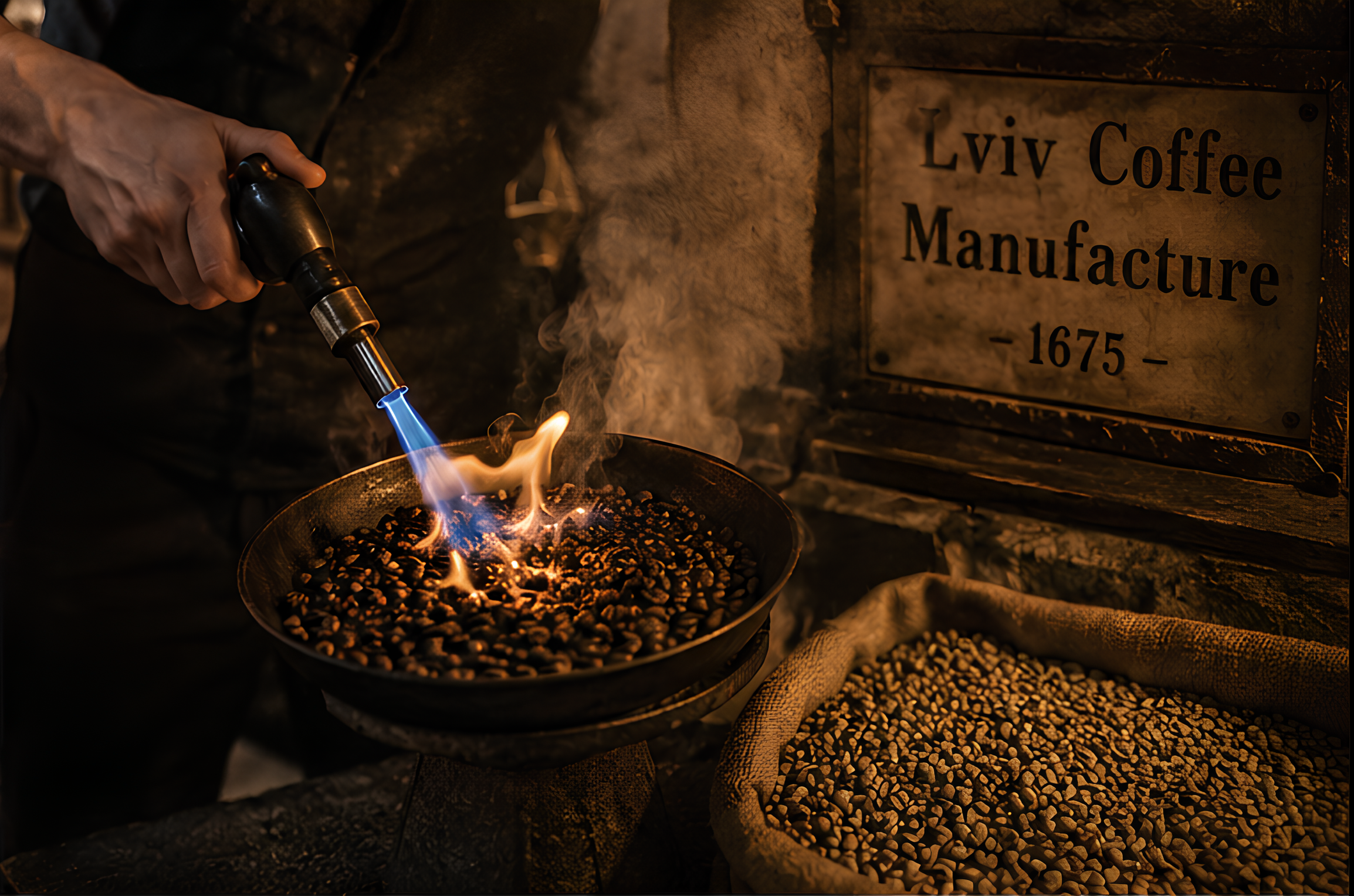
In the theatrical world of Lviv’s coffee culture, visitors can descend beneath the streets and find themselves surrounded by lantern-lit tunnels, old brick walls, wooden barrels, mining equipment, and the unmistakable smell of freshly roasted beans.
The most famous expression of this theatrical tradition can be found at the Lviv Coffee Manufacture, where coffee becomes part history lesson, part performance, and part spectacle.
One of the most recognizable rituals is Palena Kava — “Burnt Coffee.”
A cup of coffee is presented beneath a layer of sugar, which is caramelized directly in front of you. The flame briefly illuminates the dark interior, turning an ordinary cup of coffee into a small piece of Lviv theatre.
It is an experience that perfectly captures the city’s personality.
Lviv rarely separates history from entertainment. Medieval architecture becomes a restaurant interior. An old cellar becomes a coffee laboratory. A local legend becomes part of the menu.
And underground coffee mining?
Of course.
You are in Lviv.
The deeper you descend into the old cellars, the more convincing the story begins to feel. Thick stone walls retain the coolness of centuries, footsteps echo through narrow passages, and the smell of roasted coffee seems almost to belong to the building itself.
Whether or not anyone truly believes that coffee is mined beneath Rynok Square hardly matters.
The legend has become part of the city’s cultural mythology.
3. The 19th Century: When Coffee Houses Became Cultural Hubs
By the 19th and early 20th centuries, coffee houses had become some of the most important social spaces in Lviv.
The city stood at the crossroads of several cultures and political worlds, and its cafés reflected that complexity. Polish, Austrian, Jewish, Armenian, Ukrainian, and other communities contributed to the city’s intellectual and culinary life.
A coffee house was rarely just a place to order a drink.
It was an office without walls.
A newsroom.
A literary salon.
A meeting place.
A place where someone could spend several hours with a single cup of coffee and still feel that they had accomplished something important.
Writers arrived with notebooks. Journalists argued over newspapers. Politicians discussed the latest events. Artists sketched at tables. Students debated philosophy late into the evening.
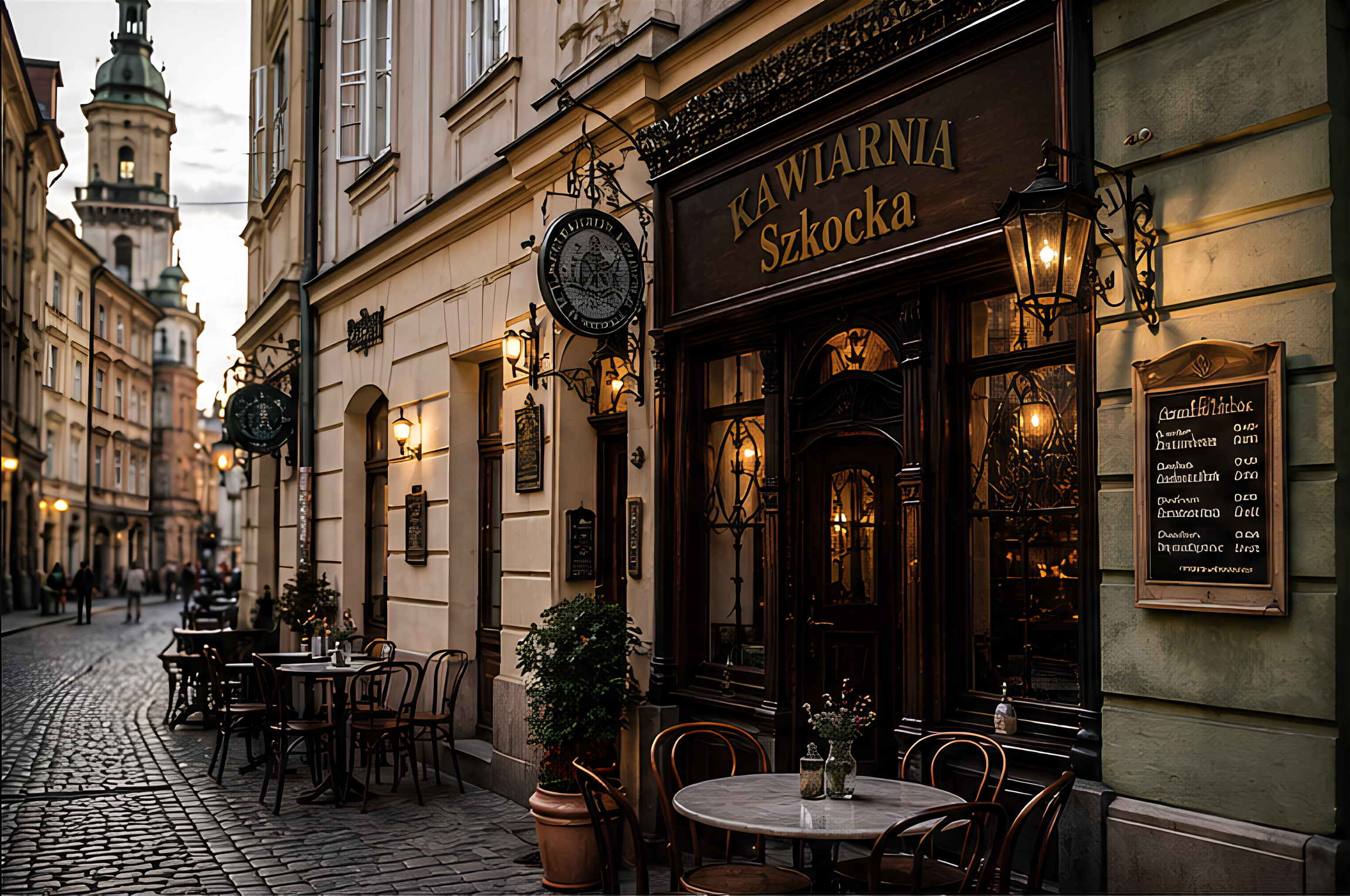
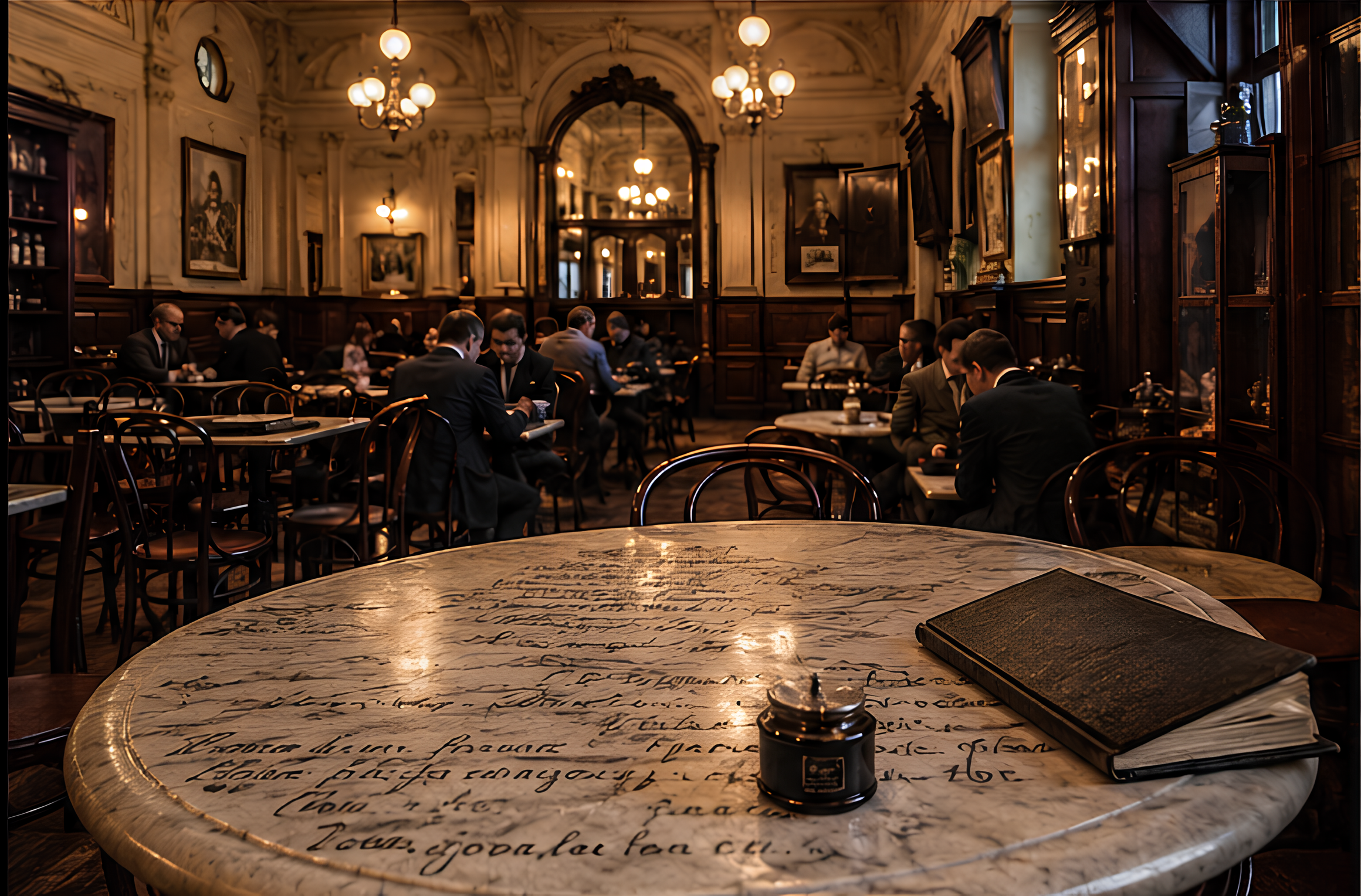
Among the most legendary establishments was Kawiarnia Szkocka — the Scottish Café, which became closely associated with the Lviv School of Mathematics.
Mathematicians including Stefan Banach gathered there to work on problems that could occupy entire afternoons. The café’s marble tables became temporary mathematical blackboards, covered with formulas and calculations.
Eventually, these conversations and problems were recorded in what became known as the Scottish Book, one of the most famous documents associated with the Lviv mathematical tradition.
The story captures something essential about old European café culture: intellectual life did not necessarily happen inside universities.
Sometimes it happened around a small wooden table, beneath clouds of cigarette smoke, beside a cooling cup of coffee.
Lviv’s cafés became extensions of the city’s streets.
You could enter one café to escape the rain and leave several hours later having met a poet, argued with a mathematician, read three newspapers, and discovered an entirely new political theory.
This culture also shaped the rhythm of the city.
Coffee encouraged people to stay.
A café was not designed around quick turnover. There was no pressure to finish your drink and leave. The table could become yours for the afternoon.
That tradition survives in Lviv today.
Even in the modern specialty-coffee scene, there remains something unmistakably old-fashioned about the city’s relationship with cafés. People meet, talk, read, work, flirt, write, watch the street, and simply sit.
The coffee is often only the beginning.
Photo Gallery: The Atmosphere of Lviv’s Coffee Culture
The most beautiful way to understand Lviv’s coffee tradition is to experience its atmosphere.
Look for intimate interiors hidden behind historic façades, warm pools of light falling across wooden tables, antique coffee equipment, handwritten menus, steaming cups beside old books, and narrow windows overlooking the cobblestones.
The city’s best coffee spaces often feel deliberately timeless.
Modern design exists, but it is usually layered over something older: a vaulted ceiling, exposed brick, carved wood, an Austrian-era façade, or a courtyard that has witnessed generations of visitors.
This mixture of old and new is what gives Lviv its distinctive café aesthetic.
4. How to Drink Coffee Like a True Lvivian
There are no official rules for drinking coffee in Lviv.
There probably shouldn’t be.
But there are a few unwritten principles worth following if you want to experience the city like a local rather than simply passing through it.
Slow down
The first rule is perhaps the most important.
Do not rush.
Coffee in Lviv is rarely at its best when consumed while walking quickly between attractions. Find a table. Sit down. Order something warm. Watch the city move outside the window.
Give yourself time.
A coffee break in Lviv can easily become an hour, and an hour can become an afternoon.
Pair it with something sweet
Coffee and dessert are inseparable parts of the local ritual.
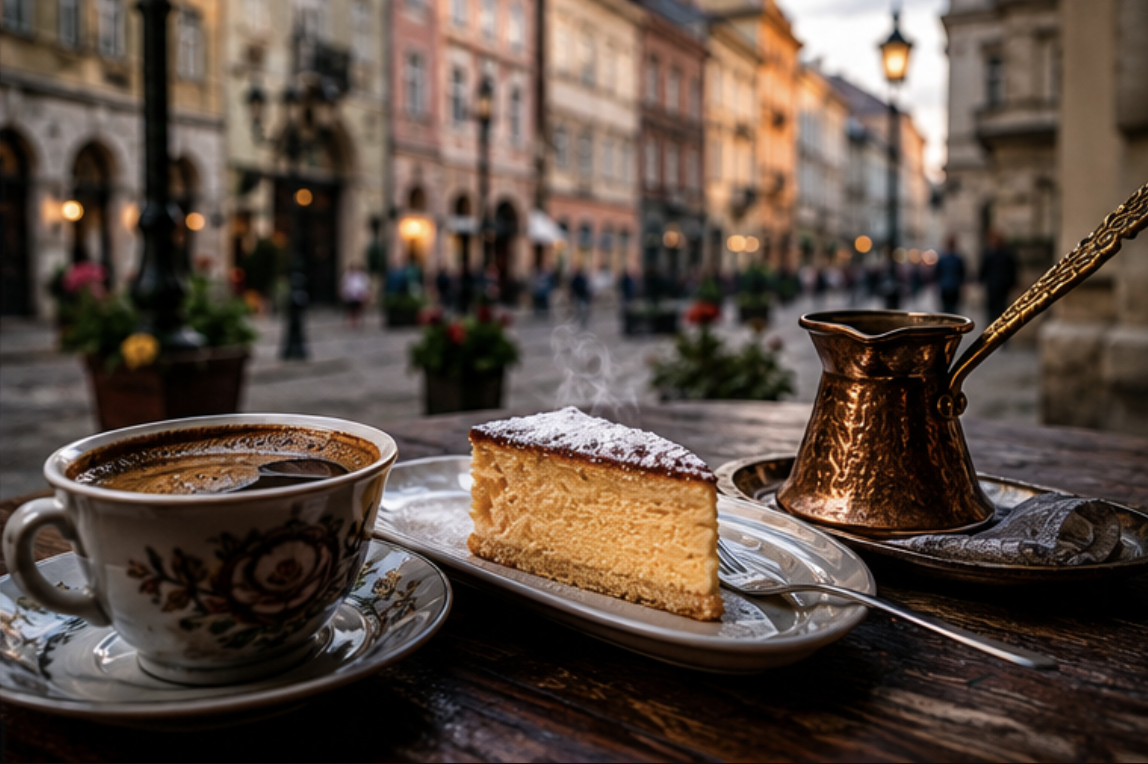
Look for Galician syrnyk, a rich cheesecake associated with the region, or choose a slice of chocolate cake, strudel, or another traditional pastry.
The combination of strong coffee and something sweet is particularly satisfying on a cold Lviv morning.
Try coffee prepared in a turka
For something closer to the city’s traditional coffee heritage, order coffee prepared in a turka.
This small vessel is used to brew finely ground coffee slowly, producing a dense and aromatic drink with sediment at the bottom.
In some places, the process itself becomes part of the experience. Watching the coffee rise and foam while the aroma fills the room creates a completely different relationship with the drink than pressing a button on an espresso machine.
Explore beyond the obvious cafés
Lviv’s coffee culture is not limited to its most famous establishments.
Some of the best experiences can be found in quiet side streets, courtyards, historic cellars, and small neighborhood cafés away from the busiest tourist routes.
Follow the smell.
Look for a doorway you would otherwise ignore.
Walk into a courtyard.
Take the stairs underground.
The city rewards curiosity.
5. Coffee as a Way of Seeing Lviv
Perhaps the greatest secret of Lviv’s coffee culture is that coffee gives you an excuse to stop.
The city can be explored quickly. You can walk around Rynok Square, photograph the churches, visit museums, cross the historic center, and check every landmark from a list in a single day.
But that is not really how Lviv is meant to be experienced.
Instead, find a café.
Sit beside the window.
Order coffee.
Then watch.
Watch people cross the square beneath old façades. Listen to conversations around you. Notice the sound of cups touching saucers and the occasional hiss of an espresso machine. Watch the afternoon light move across the buildings.
Suddenly, the city becomes slower.
The architecture becomes more detailed.
The streets become more intimate.
And coffee becomes what it has always been in Lviv: not merely a beverage, but a reason to pause and become part of the city for a while.
From the legends of Kulchytsky to the mathematical conversations of the Scottish Café, from mysterious underground coffee mines to modern specialty roasters, Lviv has built an entire mythology around a simple cup.
And perhaps that is why coffee here tastes different.
Not because the beans are necessarily better.
But because there is a story behind every cup.